Tag: resilience

  • Shining a light on hunger

    Shining a light on hunger

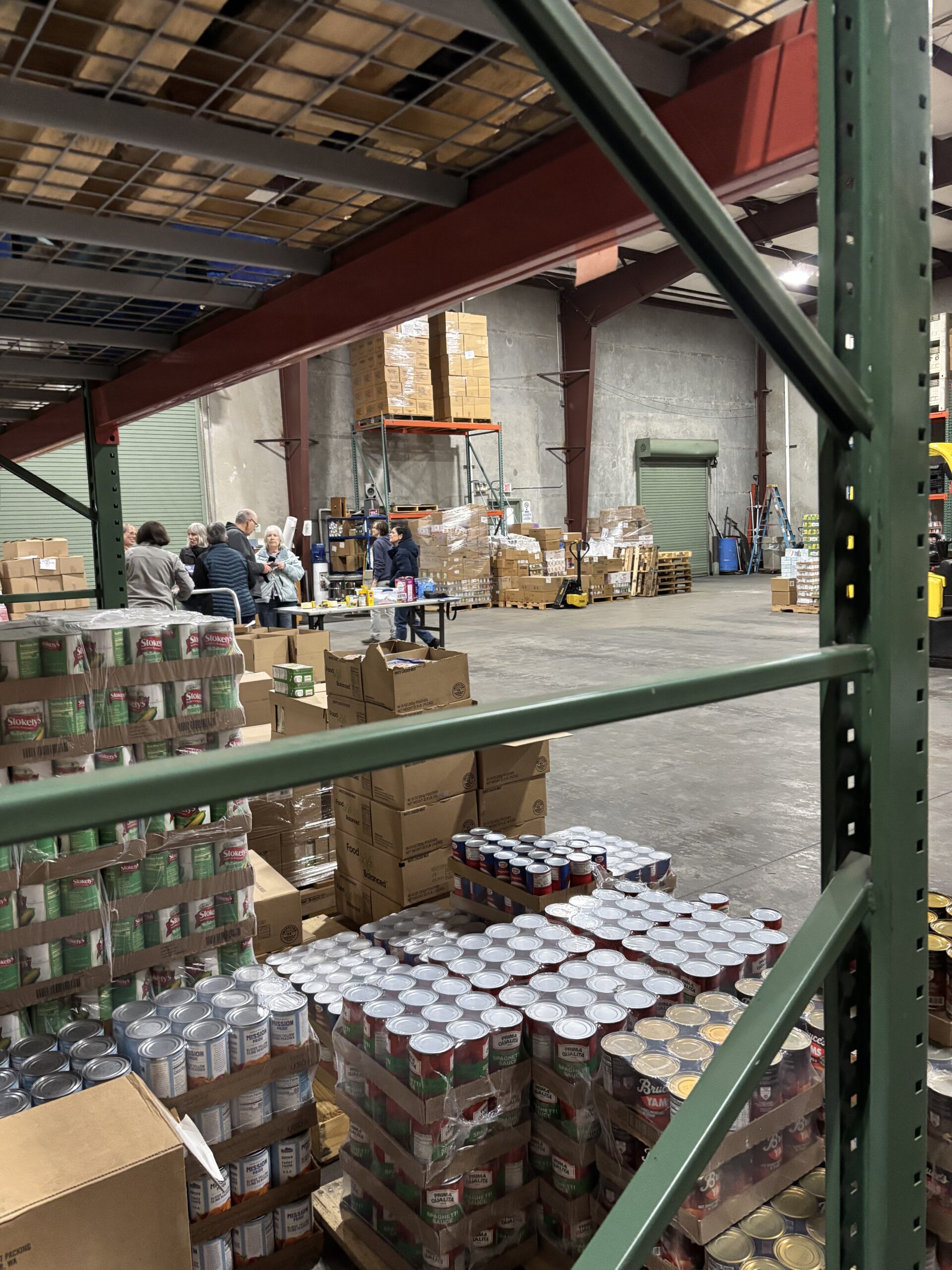
    Just before 9 AM on a Tuesday in mid-November, I pull in to the gravel parking lot of a green warehouse in Tangent, Oregon. This building belongs to Linn-Benton Food Share, which distributes food at no cost to folks throughout Linn and Benton Counties. I’m here to volunteer to pack food into around 450 boxes, which we then load onto pallets so they can be distributed to organizations such as food pantries and gleaning groups throughout our two-county region.

    There are 5 new volunteers here today, along with an equal number of veterans. I’m impressed right away by how well-organized the operation is. From the layout of the food to the printed food lists and directions from staff and experienced volunteers, it’s carefully designed to run smoothly.  Within a few minutes, I’m fully trained and packing food. The tasks of labeling boxes, filling them with the proper items, closing them up and loading them on pallets based on where they’ll go goes quickly, even with so many new folks. After our 2 hour shift I admire the neatly stacked cubes of full boxes on pallets ready to make there way out to fill peoples’ bellies.

    This warehouse has been here for many years, but this is my first time inside. I’m not proud to admit this, but I hadn’t focused all that much on hunger in our community until the Trump administration tried to withhold SNAP food assistance during the recent 43 day government shutdown. The many ways that decision rippled through our town, state, and country really got my attention. The enormity of the role SNAP plays for so many in our community woke me up to all I don’t usually see.

    According to the Oregon Department of Human Services, about 757,000 people in Oregon, or about 1 in 6 people, rely on SNAP benefits to supplement their food budget. While SNAP provides support for folks to purchase food at participating grocery stores and Farmers’ Markets, Linn-Benton Food Share distributes food directly through a network of food pantries, meal sites, gleaning groups, and agencies. To get SNAP benefits, you must apply and meet eligibility requirements and income limits. However, no proof of income or documentation is required to receive food through the food bank system Linn-Benton Food Share is part of. The idea is that these two systems together provide a safety net to prevent hunger in America. The reality, however, is quite another matter.

    As I’m packing, I ponder what’s going into each box. While this food could perhaps meet some basic nutritional needs, there are quite a few items here I wouldn’t eat unless I was really hungry. But there is also boxed milk, cereal, peanut butter, canned fruit, and pasta that are more appealing.

    When I volunteered, I was told some of these boxes go to low-income seniors once a month. But we’re packing boxes for a variety of destinations. I wonder how many of the calories the recipients need are supplied by this box, and what they eat for the rest of the month. I wonder where the food box recipients get their fresh food. I wonder how many of the items I’m packing in each box get thrown away.

    The two hour volunteer shift is a satisfying experience. The movements of packing and loading warm me up quickly in the chilly warehouse. The time goes fast, I chat with other volunteers, we finish packing all the boxes needed that day, and I get a peek into one of the components of a food assistance system I know very little about. I have many unanswered questions, but when I come back next month, I can learn more.

    I’m here because the recent SNAP crisis and efforts by the Trump regime to take away food aid from the most vulnerable people has jolted me into taking action. Whatever else I may question, I don’t ever doubt that no one should go hungry in our community, state, or country.

    I’m also here because I’m trying to understand, through volunteering, conversations, and research how the network of food assistance programs in our community works, how much it alleviates hunger and food insecurity, and how much it fails to do. I’ll keep posting about what I learn.
  • This is not a book review: Some thoughts on Sun House

    This is not a book review: Some thoughts on Sun House

    This past winter, I read Sun House, by David James Duncan. It was the best book I’ve read in a really long time, yet I’ve been reluctant to recommend it. At 764 pages and telling many interwoven stories spanning six decades, it requires a big commitment. It’s not for everyone: Duncan’s style, language, and world view is intense and unusual; reviews have been mixed. A few months after finishing the book, I read it again, and decided it’s worth the risk. So I started suggesting to friends and family that they read it. I even bought extra copies to lend out. This is a book that is helping me to imagine a different way of living at this moment in America and on Earth. Seeing a different way feels like a lifeline. 

    Sun House starts with the stories of three unconnected people and a pair of twin brothers in Oregon, Colorado, and Washington. It follows each of them through various formative experiences, joys, tragedies, and spiritual journeys until eventually they cross paths, connect with other kindred spirits, and form a community in rural Montana. 

    This is not a book review. I’m not going to try to summarize the plot, or explain what characters or story lines I found most compelling. I’m not even going to explore the big themes or messages of the book. What I will say is that Sun House is an attempt to create a new mythology for our times. If, like me, you feel trapped in a civilization that seems headed for collapse once it destroys most of the living beings, natural beauty, and life support systems on Earth, and you don’t see another way, this book might be for you too. 

    For at least 20 years, I’ve felt that I’m part of a political and economic system that is destroying the biosphere that provides us with everything we need, love, and depend on. I’ve taken many small steps to try to do less damage, yet none of them have felt adequate. As the climate continues to destabilize, and those in power slither towards fascism and kleptocracy, this feeling has deepened into heartbreak and dread. 

    Yet opting out of the system, finding an alternative, has seemed impossible to imagine, futile, costly and detrimental to my well-being. It’s felt futile because me opting out didn’t seem like it would make any discernable difference, and personally costly because I’d have to give up the comforts of modern life, and live cut off from much of what brings me ease, safety, and straightforward access to necessities, pleasures, and those I love who are far away.

    Sun House creates an alternative that feels meaningful and perhaps even possible. Here’s what I took from the story: As our politics, economic system, and extreme wealth and power inequality continue to destroy life and climate stability, small bands of people can start and build communities and modes making a living that will serve as lifeboats: protected reserves of living things, skills, information, cooperative systems, love of nature, integrity, and sacred knowledge. As end-stage capitalism destroys huge swaths of life on earth, these lifeboat communities might provide shelter to preserve enough life, beauty, skills, and knowledge to restore life and beauty and reinhabit earth after industrial civilization has fallen and the great cycle of destruction we’re in has run it’s course.

    Duncan’s tale is an attempt to show how such a lifeboat might be born and develop in the midst of our human-shattered world. And for me, his fable succeeds. 

    There’s just one more thing I want to say about why I loved this book. In Duncan’s tale, there are no litmus tests for entry into the community, except to value and revere other living creatures.  People there still use cars and machinery and run businesses—although with a focus on reducing consumption and waste. Some live lives that include frequent flying or driving, and some eat meat. I could write a whole separate essay on why this lack of purity testing is so important to me, but I won’t. I’ll just say that anyone who has been working for environmental progress and climate action for any amount of time knows that our different approaches have often prevented us from uniting enough to fully work together. 

    Sun House took me on a journey that fully enveloped me, as only the best books can do. It took several hundred pages to get into, and I found it somewhat uneven going. There were some sections of the book I didn’t even like. Yet this book allowed me to start imagining new possibilities for building lifeboats. I now see the seeds of these lifeboats in people and places I didn’t see before. I am now seeking out ways to contribute to a lifeboat in my community. Sun House did this for me. Maybe it won’t do that for you. But on the chance that it might, I suggest you give it a try.

  • How to prepare for the unknown

    How to prepare for the unknown

    We humans are notoriously bad at predicting the future. I personally was blindsided by all three of the life-threatening crises we faced in 2020 in western Oregon – a global pandemic, a deadly heat dome, and an air quality crisis from wildfires that made it unsafe to go outdoors or even open the windows. Disaster preparedness in our region, such as it is, has been focused on preparations for a major earthquake.  And certainly, given the seismic history of the Pacific Northwest, there could be a catastrophic earthquake here anytime. But the next disaster might also be something no one is thinking much about.

    As the climate destabilizes along with America’s political and social fabric, I’ve been wondering if it’s possible to prepare for events you never saw coming.

    Maybe, maybe not. I really have no idea. But here is what I do know: Taking actions to increase our household’s disaster preparedness and resilience feels worthwhile and empowering. So I’ve developed a kind of three way test to decide what steps to take. 

    1. Does the action have benefits in some imaginable crisis situation? 
    2. Does the action have other benefits that I can feel or see in my daily life?
    3. Is the action relatively easy and affordable?

    Here are some of the actions I’ve taken because the answer was yes to all three questions. I put together a go bag.  I put a box in the back of my car with several bottles of water, an emergency blanket, a map, a large garbage bag, and a few snacks. We now keep one of our vehicles fully fueled up and ready should we need to leave quickly. I bought a radio that can be recharged with a solar battery or by winding a crank.  I made a list of things to grab in case of an evacuation and put it on my bulletin board.  I started maintaining a non-perishable food supply in our garage that includes about a week’s worth of water and gas for our camping stove. We also put together an earthquake kit in a big duffel bag.

    There are other things I’m giving extra attention to as I focus more on resilience. These include gardening for food and pollinators, connecting more with our neighbors, shopping more at the farmers’ markets, and seeking other ways to build and support a vibrant local food system. I signed up for emergency text alerts from the city and county. We have a fully electrified home, so I was able to get the gas line to our house shut off permanently.

    I’ve also been thinking about ways to connect with other people nearby who want to build local resilience and share ideas and support. I haven’t found a local resilience group yet, so it’s possible I’ll need to try to start one. That’s a topic for another day!